Table of Content
 The Death of the "Click" and the Emergence of the AI Intermediary
- Case Study: The New York Model of Machine-Readable Data
- How Shopify App Development in USA is Shifting to AI-Agent APIs
- Why Your Shopify Web Design in USA is Currently Invisible to AI
- The "Technical Debt" Challenge: Why USA Owners are Invisible to AI
- The Secret List of Shopify Stores in USA Winning the AI Race
- Shopify Fulfillment USA: How to Sync Logistics for 1-Hour AI Purchases
- Why a Shopify Developer in USA Must Now Be a 'Data Architect
- The Checklist for 2026: Rebuilding for the Agentic Ecosystem
- Visualizing the Future: The Agentic Commerce Ecosystem
The digital storefront as we know it is facing a terminal decline. For twenty years, success for a Shopify store owner was defined by a single metric: the click. You built beautiful sites to capture human eyes, used psychological triggers to encourage browsing, and optimized for keywords to climb search results. But as we approach 2026, the human browser is being replaced by an autonomous AI agent. This new consumer, the "Silent Shopper," does not scroll through your collection or admire your brand story. Instead, an intelligent AI agent like Google’s AI Mode or ChatGPT Search evaluates your data, checks your inventory, and executes a purchase without a single human ever visiting your homepage.
We are seeing Manhattan’s elite merchants gutting their technical architecture to prepare for this shift. The game has moved from ranking to grounding. If your store is not prepared for Artificial Intelligence and intelligent agents, your brand will effectively vanish from the digital economy by 2026..
The Death of the "Click" and the Emergence of the AI Intermediary
Traditional search traffic is entering a period of structural decline as Google’s AI Overviews and generative search engines increasingly answer user queries directly. When a shopper asks an AI agent to find the most durable, eco-friendly yoga mat under $50, the agent no longer returns a list of blue links. Instead, it synthesizes information from across the web, identifies the best option, and may even prompt the user to complete the purchase.
In this new search paradigm, visibility alone is no longer enough. To remain competitive, brands must position themselves as the primary citation that AI agents rely on when generating answers and recommendations.
This is one of the most critical challenges facing Shopify store owners in the USA today. When a store’s data is fragmented, inconsistent, or difficult for machines to interpret, conversational AI agents are far more likely to bypass it in favor of competitors with cleaner, more structured signals.
As a Shopify-focused agency, SANOMADS specializes in Generative Engine Optimization (GEO). We go beyond traditional SEO to position your brand as an authoritative source that AI systems and intelligent agents consistently trust, cite, and recommend.
Case Study: The New York Model of Machine-Readable Data

The best Shopify stores in the USA have recognized that their old, cluttered systems are a liability. These brands have created a Knowledge Graph for their products, allowing machines to understand their catalog as clearly as a human does.
Steve Madden
Historically, Steve Madden operated 30 global sites, resulting in a "Frankenstack" of over 260 apps that slowed performance. To solve this, they migrated to a centralized architecture.
- Headless Hybrid Migration: They moved to a centralized system to regain technical control.
- The Unify Integration: They used a robust connection between Content stack and Shopify Liquid to serve standardized data.
- Machine-Readable Feeds: This allows an AI agent to find real-time price and localized stock validated by a single source of truth.
- Measurable Impact: This transition achieved a 16.5% increase in conversion rates by cleaning the data architecture.
Bombas
Bombas faced a unique challenge with its unisex product model. A single physical item might serve a men's small and a women's large. This overlap created confusion for automated discovery tools that rely on precise identifiers.
- Platform Migration: This transformation involved a large-scale migration from Magento to Shopify Plus, focusing on site stability.
- Virtual SKU Mapping: They implemented a custom system that translates complex inventory into clean, machine-parsable data.
- Real-Time Synchronization: By connecting their inventory to a custom 3PL middleware, Bombas ensures that their data is always real-time.
- Confidence in Citations: This technical depth is exactly what Artificial Intelligence and intelligent agents require to cite a brand with 100% confidence.
How Shopify App Development in USA is Shifting to AI-Agent APIs
Today, Shopify app development focuses on the Agentic Commerce Protocol (ACP). This allows a conversational AI agent to talk directly to your store's backend.
- Secure API Bridges: At SANOMADS, we connect your Shopify store to your ERP and CRM for real-time order syncing.
- Autonomous Workflows: We use n8n to build agentic workflows that handle topic selection and scheduled publishing.
- ERP Integration: Our Shopify professionals integrate platforms like Sage, Odoo, and Microsoft Dynamics so data flows freely.
Why Your Shopify Web Design in USA is Currently Invisible to AI
Most web design is optimized for human eyes, but high-resolution images are noise to an intelligent AI agent. To be visible, you must become "Machine-First, Human-Friendly." As a leading Shopify web design company, SANOMADS implements:
- Semantic Hierarchy: We use strict header tags for passage-level retrieval by AI.
- Structured Metadata: We move product specs out of images and into standard metafields.
- AI-Generated Imagery: We use AI to create bulk variant renders and lifestyle mockups that are optimized for AI agents examples.
The "Technical Debt" Challenge: Why USA Owners are Invisible to AI

One of the most significant challenges facing Shopify store owners in the USA is accumulated technical debt. Over years of growth, many Shopify stores have installed dozens of third-party apps for rewards, reviews, analytics, and pop-ups. This layered app ecosystem often injects excessive JavaScript, increasing page weight and slowing down crawl efficiency for AI-driven systems and search engines.
As a Shopify website development company, SANOMADS helps you:
- App Stack Audit: We target a 30% reduction in third-party scripts to improve Core Web Vitals.
- Native Feature Migration: We replace external apps with native Shopify Flow and Meta-objects.
- LCP Optimization: Our goal is to achieve a Largest Contentful Paint of under 2.5 seconds.
The Secret List of Shopify Stores in USA Winning the AI Race
There is a growing list of Shopify stores in the USA that are already dominating the AI overview section of search. These top Shopify stores treat their product data as a strategic asset.
- Colourpop: This brand secures its spot among the best Shopify stores in the USA by optimizing its massive beauty catalog for machine discovery. By structuring their shades and skin-type metadata through the Shopify Catalog API, they ensure an AI agent can recommend the exact product a user needs.
- Gymshark: Gymshark transitioned from Adobe to Shopify Plus to leverage advanced AI for personalization. They utilize Algolia Recommend to process behavioral cues, resulting in a 150% increase in order rates during peak events. By integrating with Google Cloud's Vertex AI, they created expert assistants that guide the community through goal-driven product selection.
- Fashion Nova: As a leader in Shopify in usa fast-fashion, Fashion Nova uses AI for real-time trend analysis and intent recognition. Their architecture leverages visual product signals, allowing an AI virtual agent to find items by style or occasion even when user queries are imprecise.
Shopify Fulfillment USA: How to Sync Logistics for 1-Hour AI Purchases

The promise of the Silent Shopper is not just discovery: it is execution. If an AI agent finds your product but detects a slow shipping window, it will logically recommend a competitor with same-day delivery.
At SANOMADS, we provide the technical infrastructure required for the "1-Hour Purchase Cycle":
- Inventory Reconciliation: We implement automated inventory updates via real-time API or webhook triggers to ensure your stock data is never stale.
- Custom Fulfillment Services: We develop custom apps for third-party fulfillment and product inventory tracking to eliminate data lag.
- Back-Office Connectivity: By integrating your Shopify store with your existing warehouse management systems, we ensure an AI agent always sees accurate delivery ETAs.
Why a Shopify Developer in USA Must Now Be a 'Data Architect
The role of the Shopify developer has evolved. Supporting today’s Shopify store owner now requires more than front-end execution. It demands data architecture thinking. At SANOMADS, our Shopify specialists in the USA focus on:
- Unified Commerce Modeling: We centralize your inventory and order data so it is fetchable by autonomous machines.
- API Orchestration: We bridge the gap between your store and the broader agentic ecosystem.
- AI-Native Building: We do not just use AI: we build with it to create self-healing workflows and predictive insights.
The Checklist for 2026: Rebuilding for the Agentic Ecosystem
To ensure your store is ready for the Silent Shopper, we recommend this technical roadmap:
- Implement the Shopify Knowledge Base App: Train AI systems using structured FAQ data so responses remain accurate, brand-safe, and aligned with verified store information..
- Use JSON-LD Schema Markup: Serve data in a lightweight format so an AI agent can parse your site in milliseconds.
- Switch to Headless Commerce: Decouple your frontend to serve AI agents’ requests faster using Hydrogen or Next.js.
- Deploy an 'llms.txt' Manifest: Provide a concise Markdown summary of your site specifically for Large Language Models to index.
- Conduct a 'Frankenstack' Audit: Work with experienced Shopify agencies in the USA to reduce unnecessary apps, reduce technical debt and improve site performance.
Visualizing the Future: The Agentic Commerce Ecosystem

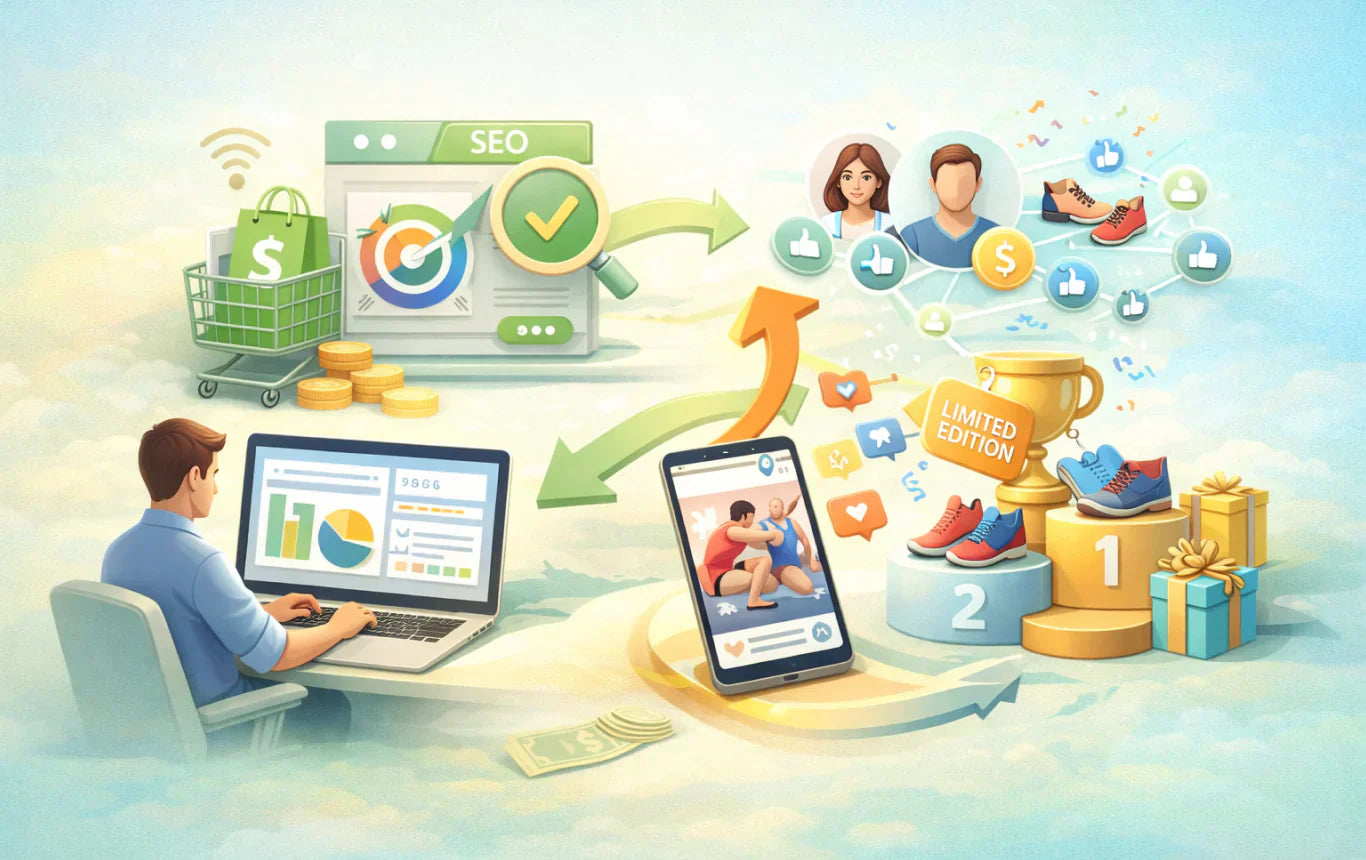
Imagine an ecosystem where a Shopify store functions as a structured data node, not just a traditional website. A human user communicates their intent to a personal AI agent. That agent queries Shopify’s global catalog, verifies availability through catalog APIs, and completes the purchase through agent-driven commerce workflows.
This is the emerging future of Shopify for business owners. Success will increasingly depend on how effectively your store communicates with machines.
The shift is clear. Stop building solely for the human click and start building for machine citation, structured data, and AI trust signals. Brands that adapt early will be the ones discovered, cited, and chosen in the next phase of commerce.